.svg "Select English site")
.svg "Select German site")
.svg "Select French site")
Safety and certification
Safety must always be paramount. Our large and heavy engines running at speed present a hazard in and of themselves - leaning across a running track working on an engine and being hit by a train running at full pelt in the other direction will hurt you (and quite likely the expensive engine too).
On this page you will find advice on fuel safety; how to safety-check live steam engines; boiler testing regulations and documentation; and a diagnostic procedure for fault finding on live steam engines.
Fuel safety
Fuel-related risks include: working on meths and gas fired engines in enclosed spaces such as a garden shed, where explosive vapours can build up; spilling fuel whilst refuelling near a running line; knocking over fuel containers; and confusing fuel and water containers.
In one particularly serious incident, a contributory cause to the accident was the presence in the steaming bay of large-volume containers of alcohol fuel and boiler water. Although the fuel was coloured, the lack of visual and physical separation led to an error during an emergency situation when fuel was thrown rather than water.
Minimising fuel risk relies on two principles:- clear labelling, and
- physical separation of fuel reserves from sources of ignition.
- Alcohol fuel must be coloured.
- Alcohol fuel must only be brought to meetings in the original, labelled, retail container. These containers are officially approved for both transport and storage.
- No more alcohol fuel may be brought to a meeting than is required for the anticipated running at the event.
- Retail fuel containers should be placed in a cool, secure storage area; as remote as possible from the open flames at the steaming bay and trackside; and also, from groups of operators and spectators. No other material (such as boiler water) should be permitted at this location.
- Alcohol to be transferred into locomotives should be loaded, in the open air, into fuelling containers that contain no more than 500ml. Transfer should be done away from the storage area; and remote from the steaming bay and trackside where open flames are present.
- Fuelling containers such as bottles and syringes must be translucent to show the coloured fuel contents.
- Bottles must have a cap or positive closure so that fuel cannot escape when not in use.
- Fuel containers must be clearly marked with the contents.
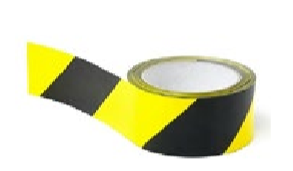
Where size permits, fuel must be identified with a flame pictogram label
 and/or black and yellow warning tape
  .
.
- Wet cloths and water in large spray bottles or buckets should be placed at the steaming bay and convenient trackside locations to douse small leaks and fires; reducing track damage and further spread.
- A CO2 extinguisher and fire blanket should be available to extinguish larger fires.

Safety checks for live steam engines
The guidelines for testing and inspection of boilers place great emphasis upon a regular safety check of the boiler and its fittings. Fittings include any items which are screwed into or bolted onto the boiler that have access to the water space – e.g. steam and water feed pipes, regulators, control valves, check valves, water sight glass and mountings, safety valves, whistle valves as well as pressure gauges.
Just as one should regularly check the condition of your tyres, the engine oil, screen washer fluid, brake fluid and lights of your car, likewise even if you do not obtain a formal boiler hydraulic test certificate, or simply rely upon the manufacturer’s certificate that came with your locomotive, one should still examine it carefully from time to time and record the findings of the examination. The boiler documentation made available by the association allows the recording of this examination.
So, how does one go about it?
The examination should be carried out in two parts. Firstly when the boiler is cold, secondly when it is steamed. As an inspector, I would prefer the model to be shown to me in its running condition. By that, I do not want pipework polished, paintwork gleaming, as the cleaning process might remove tell-tale signs of seepage, etc. I want to see it, ‘warts and all’. Remember we are not judging a competition entry, but making a safety assessment.
Part 1 - cold, dry test
At this examination the inspector is required to carry out the following as a minimum, together with such other inspections and tests as considered appropriate and necessary
- Check the integrity of the pressure vessel(s) and associated pipe work and valves including superheater(s) and economiser(s). Here you are looking for any signs of damage – dents, lumps, scars, abrasion of pipework, nuts in line with pipes, nipples intact, sight glass clean, etc.
- Check the integrity of the boiler framing, settings, insulation, casing and cladding. Looking for signs of wear/movement or damage.
- Check all parts for wear and corrosion. See above.
- Check specifically the condition of safety valve(s), pressure gauge(s), water level gauge(s), main steam stop valve(s), blow-down valve(s), check valve(s), etc. Are there water stains or green deposits? Is it possible to unscrew the valve spindle completely? Do all stop valves close and open. Note the reading on the pressure gauge when the boiler is cold. Is it zero or not?
- Check, that the water passages of the water level gauge(s) are unobstructed and that the gauge glass isolating and blow-down cocks (if fitted) operate correctly. With some water in the boiler, tilt it up and down. Does the water level rise and fall and return to the original state when the boiler is level again? Do electronic water level systems indicate high/low levels when tilted?
- Check that the pressure gauge(s) have a red line at the correct maximum permissible working pressure of the boiler. A red line on the face of the dial is preferable, but a red dot on the outer bezel will be acceptable provided it is immovable.
- Consider the adequacy of the boiler feed water supply arrangements. Check the hand pump if fitted. Use the owners filling method where possible. If the boiler is filled using a detachable hand pump, the operation of the filling valve that needs to be checked. The point being that one can top up the boiler if it becomes necessary. A stuck filler valve is of no use at all.
Part 2 - steam test
The second part of the examination is required to be carried out with the boiler fully assembled and under steam. I like to observe the engine whilst steam is being raised. It is required that the boiler should be fired for the test as for normal service and that the pressure should be raised so as to lift the safety valve(s). At this examination the inspector is required to carry out the following as a minimum, together with such other inspections and tests as he considers appropriate and necessary.
- Check visually for correct assembly of all components flanged connections and pipe joints. Are steam valves arranged to prevent unscrewing in use? Are end plates showing any signs of bulging? Are there any signs of seepage or green copper salts at pipe joints?
- Check the correct operation of main steam stop valve(s), blowdown valve(s), water inlet check valve(s), pressure gauge(s), gauge glass isolating and blow-down cocks (if fitted).
- Does the pressure gauge react to changes in pressure as steam is raised.
- Check that the operation of the safety valve(s) controls steam pressure to within an acceptable margin of the specified maximum permissible working pressure. During the examination, with the blower operating/gas burner lit, the pressure gauge should not rise more than 10% above the working pressure at any time. What pressure does it blow at? Is it within ten percent of the working pressure. What pressure does the valve reset itself.
- Check the operation of at least one means of supplying feed water to the boiler. Pump water into the boiler by the usual means.
- Check visually for steam and water leaks. Not necessarily a cause for failure, but notify the owner.
- Consider any other factors affecting the safety of operation of the boiler. Can the fire be dropped/extinguished rapidly if required?
So, to summarise, the safety examination is not onerous or difficult. Indeed, it could be done on a ‘buddy basis’. (I will examine your boiler, you check mine.) Certainly this could assist those members living any distance from a registered boiler inspector. It requires an enquiring inspection of the locomotive boiler and fittings. Any staining, evidence of seepage, or decay (green copper salts around bushes for example) should be investigated. Minor leaks from pipework joints are not in themselves cause for failure, but do indicate where work may be required. Finally do record the inspection and one’s findings. The record should be retained by the owner of the boiler and passed on to any subsequent owner. A boiler that has a full record of inspection will command a higher value than one with an unknown history.
Keith Bucklitch
Documents for boiler testers
Boiler inspector's personal record
Boiler test code volume 2 - Boilers under 3 bar litres (2018)
Boiler test code volume 3 - LPG tanks under 250ml (2018)
What to do when it doesn't go - diagnostic flow charts
The challenge and the charm of live steam is that every engine is different and responds differently to ambient conditions: they have pesonality. Unfortunately this extends to those occasions when an engine refuses to run.
In Newsletter 173 (April 1997) Dick Moger and Barry Applegate (with support from Tony Hall-Patch) published a guide to fault finding in Gauge One engines in the form of annotated flowcharts which you can download here.